

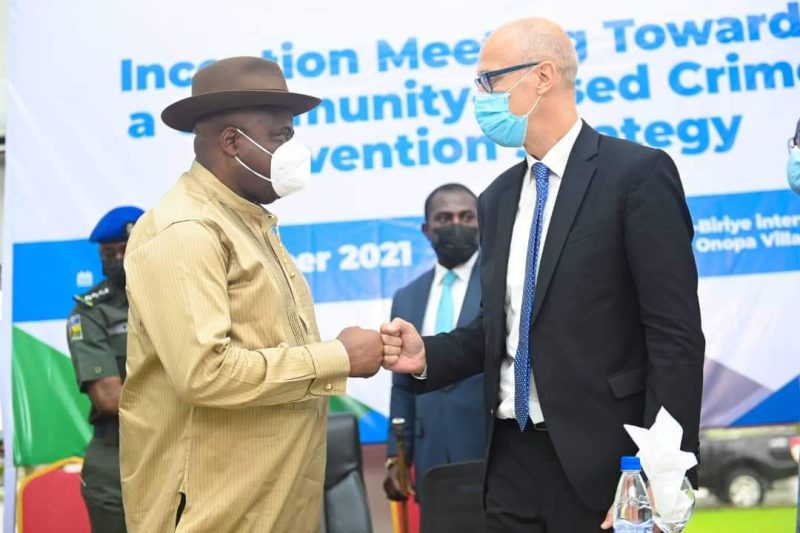
Yenagoa—Governor Douye Diri of Bayelsa State has expressed concern over the rate of insecurity occasioned by sea piracy, drug abuse, human trafficking and other criminal activities in the Gulf of Guinea.
Diri made this known on Tuesday at a United Nations-backed workshop on combating piracy and maritime insecurity in the Gulf of Guinea, according to a statement by his chief press secretary, Daniel Alabrah.
The Governor who spoke during the opening ceremony of the three-day programme at the Chief Harold Dappa Biriye Conference Centre in Yenagoa, condemned the level of insecurity in the Gulf of Guinea.
He noted that the maritime industry was the backbone of the global economy and that no effort should be spared in tackling the menace.
While appreciating the initiative of the United Nations Office on Drugs and Crime (UNODC) to curb the menace, Diri noted that his administration would support the body to actualise the goals of the project.
He also expressed readiness to host the Gulf of Guinea Security Conference in collaboration with major stakeholders to unravel the root causes and design a regional approach to combat the scourge.
“The malady might be preponderant in the Gulf of Guinea but it is equally a crisis of global dimension. Sadly, sea piracy is not the only security threat undermining us at sea and along our waterways.
“It has also focused spotlights on wider complications of maritime insecurity such as trafficking and smuggling of humans, weapons, narcotics and unregulated and illegal fishing.
“Bayelsa State is prepared to provide leadership and embrace international best practices to fight and prevent crime. I have no doubt that this project would be fundamentally beneficial to our people and state.
“We have traditional ties, through trade, religion, culture and ethnicity across the subregion, and this creates a platform for our modern security collaboration,” he said.
The Governor who called on the United Nations to support his administration in the area of youth empowerment also urged the federal government to be equitable when allocating resources to the Niger Delta.
The United Nations Country Director on Drugs and Crime, Dr. Oliver Stolpe, in his remarks, noted that the Gulf of Guinea was the most dangerous maritime area in the world with 25 sea piracy attacks in 2020.
Stolpe described the rate of drug use in Nigeria as three times higher than the global average.
He maintained that the fight against insecurity can only be attainable if drug abuse was effectively controlled.
While appreciating the state government for the initiative, he stressed that it would enable local communities to prevent crime.
He further called on stakeholders to leverage on the community-based approach to address drug use and prevention.
Government appointees, traditional rulers and civil societies from Bayelsa, Rivers, Akwa Ibom and Cross River states participated in the three-day programme.


