

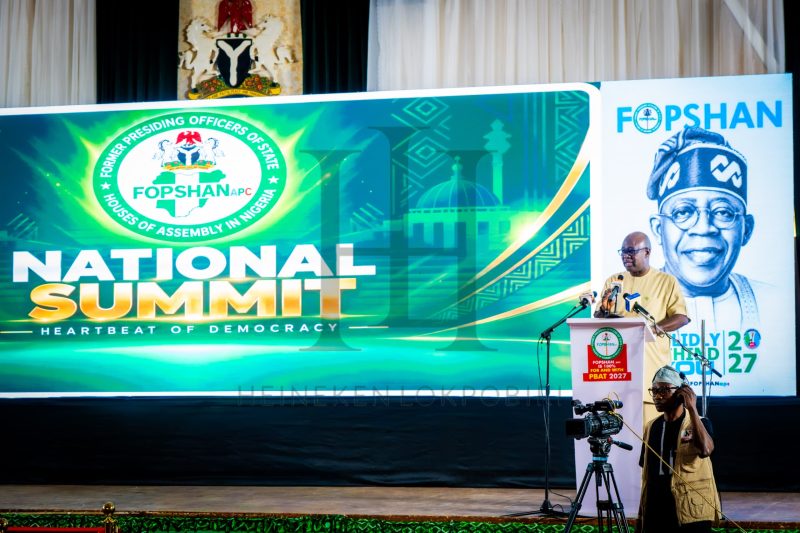
Nigeria’s oil Minister, Senator Heineken Lokpobiri, says reforms by President Bola Tinubu’s administration have boosted oil production, restored investor confidence and revived drilling activities in Nigeria’s petroleum sector.
Lokpobiri stated this in his goodwill message at the National Summit of Former Presiding Officers of State Houses of Assembly in Nigeria (FOPSHAN) with the theme: “Bold Leadership, Bold Reforms: From Subsidy to Renewed Hope.”
According to him, assessment of the administration’s performance must start from where it met the sector in May 2023, when production was about one million barrels per day, investment was declining and drilling activities were stalled.
“An assessment of the achievements of the Renewed Hope Administration must start from where we were as a nation before May 2023 and where we are today, particularly in terms of production capacity,” he said.
He disclosed that production has since recovered to about 1.8 million barrels per day, reaching above that figure at different points in 2026.
The Minister attributed the recovery to deliberate interventions by the President, including resolution of long-standing industry issues, improved security, regulatory certainty and measures to attract capital back to upstream operations.
Lokpobiri said active drilling rigs increased from about 14 in 2023 to over 60, indicating expansion in exploration and production.
“A rig is not merely a number. It is capital deployed, wells being drilled, Nigerian contractors working, services being provided and ultimately new production. The rig today means production tomorrow,” he said.
He added that Nigeria has secured over $8 billion in major upstream Final Investment Decisions since 2023, including $5 billion Bonga North, $550 million Ubeta and $2 billion Shell HI projects.
The Minister also cited the conclusion of previously stalled divestment transactions involving International Oil Companies, which he said has enabled Nigerian operators to deploy capital and increase production. Indigenous companies now account for a significant share of national output.
On fuel subsidy removal, Lokpobiri said the regime cost over N4 trillion in 2022, estimated at N18.4 billion daily at its peak, noting that deregulation has created room for competition, private investment and domestic refining.
He identified the 650,000 barrels-per-day Dangote Refinery and other local refineries as key structural changes, adding that 53.7 million barrels of crude and condensate were supplied to local refiners in Q2 2026, with Domestic Crude Supply Obligation performance at 97.4 per cent.
“The story of this administration in the petroleum sector is not just about what we have achieved today. It is about the productive capacity we are building for tomorrow,” Lokpobiri said.
He urged FOPSHAN members to engage citizens on the measurable outcomes of the reforms, stressing that projects being developed today will deliver between 2027 and 2029 and beyond.


