

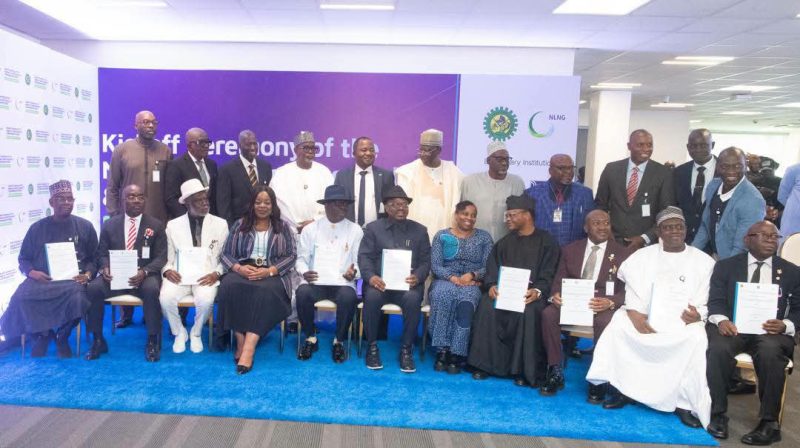
The Nigerian Content Development and Monitoring Board (NCDMB) and Nigeria LNG Limited (NLNG) have launched a $9 million professorial chair endowment programme across six Nigerian universities.
It was gathered the aim is to develop commercially viable solutions to industry challenges, strengthen local research capacity, and advance technological innovation.
Under the Nigerian Content Research and Development (NC-R&D) Professorial Chair Endowment Programme, each university will receive $1.5 million to establish a specialised professorial chair focused on agreed industry research priorities.
A statement signed by Sophia Horsfall, General Manager, External Relations and Sustainable Development, and Obinna Ezeobi, Ph.D, General Manager, Corporate Communications Division, NCDMB, said the initiative is being implemented in partnership with the NCDMB, under the supervision of its Planning, Research and Statistics Directorate.
The beneficiary universities are the University of Ibadan, Rivers State University, Modibbo Adama University, Yola, Aliko Dangote University of Science and Technology, Kano, University of Nigeria, Nsukka, and Yakubu Gowon University, formerly the University of Abuja.
Speaking at the kick-off ceremony, NLNG’s Managing Director and Chief Executive Officer, Adeleye Falade, described the programme as an investment in Nigeria’s capacity to translate academic knowledge into practical solutions.
In his keynote address titled “Reshaping Nigeria’s Future Through Innovation, Research and Capacity Development,” Falade emphasised sustained collaboration between government, industry, and academia.
“In the energy industry, we understand that technology and energy systems are evolving and the requirement for sustained research cannot be overemphasised,” he said.
He noted that the programme would support research into challenges central to the industry’s future, including improving operational efficiency, managing emissions, strengthening safety, maintaining critical infrastructure, and making industrial processes more sustainable.
Falade also outlined a “triple helix” approach that brings government, industry, and academia together through specialised programmes, sabbaticals, exchange opportunities, practical testing of research assumptions, and joint development of postgraduate curricula.
The six universities will undertake research in distinct areas, while the NLNG Research and Innovation Centre for Computer and Electrical Engineering (RICCEE) at Rivers State University will serve as the coordinating point for collaboration.
Falade said discussions were already underway with the university on implementation arrangements and commended its Vice-Chancellor, Professor Isaac Zeb-Obipi, for advancing the collaboration.
“We have already gotten indications of other partners like Google, Cisco and MTN who are showing interest to support this initiative,” he said.
He highlighted opportunities for younger researchers to deepen their expertise, investigate industry problems, and learn from experienced academics and practitioners.
He urged the institutions to build on the endowments by strengthening research partnerships, attracting additional funding, and pursuing the commercialisation of intellectual property.
“Expand the scope, reach for more grants and funding which can push the frontiers of knowledge and commercialisation of intellectual property,” he said.
Falade acknowledged NCDMB’s role in bringing the initiative to fruition and called for sustained commitment to technology transfer and home-grown solutions without compromising quality assurance or safety.
He said the programme’s lasting value would lie in stronger institutions, research outcomes deployed in the field, and the development of the next generation of Nigerian researchers and industry professionals.
In his remarks, the Executive Secretary of the NCDMB, Engr. Felix Omatsola Ogbe, said the $9 million endowment represents a strategic investment in the future of Nigeria’s research and innovation ecosystem.
He said it complements the Board’s ongoing investments in research infrastructure, including the establishment of specialised R&D Centres of Excellence across six universities in the country.
“Taken together, these interventions demonstrate the Nigerian oil and gas industry’s commitment to creating an integrated research ecosystem that connects academic expertise, modern research infrastructure, industry requirements, and commercialization opportunities,” he said.
Represented by the Senior Technical Adviser, Engr. Austin Uzoka, the Executive Secretary said by supporting specialised professorial chairs in critical areas, NLNG and NCDMB are bridging the longstanding gap between academic research and industrial application.
He charged the universities to deliberately transition from research for publication to research for application, and from innovation as an academic pursuit to innovation as a driver of industrial transformation.
“The beneficiary universities must see this endowment as both an opportunity and a responsibility and they would be expected to deliver clearly defined research objectives, measurable outcomes, prudent resource utilization, effective stakeholder engagement, and sustained collaboration with industry partners,” he said.
He added that the chairs are expected to generate commercially viable solutions, strengthen local technological capabilities, support industrial competitiveness, and contribute meaningfully to the long-term sustainability of Nigeria’s oil and gas industry.
Details of the endowment show that the University of Ibadan will focus on natural gas processing, pollution control, and environmental management, while Rivers State University will concentrate on digital engineering, intelligent energy systems, automation, and asset integrity.
Modibbo Adama University will undertake research in energy transition and the environment. Aliko Dangote University of Science and Technology will focus on sustainable energy innovation and climate-resilient food systems.
The University of Nigeria, Nsukka, will specialise in green energy production and geoenvironmental engineering, while Yakubu Gowon University will focus on geoscience and satellite intelligence for resilient gas infrastructure.
Each university will work towards agreed research targets and commercialisation pathways, providing a framework for measuring progress and translating findings into practical applications.
The institutions will also jointly host an information management hub to support knowledge sharing and exchange programmes.
The funding includes provision for minor civil works and infrastructure upgrades to transform identified spaces into fit-for-purpose research centres.
Proposed arrangements would enable industry professionals to contribute practical expertise in technical and non-technical disciplines while pursuing master’s and doctoral degrees. This would give students greater exposure to industry experience while strengthening the connection between postgraduate study and practical problem-solving.
The statement noted that the programme reinforces NLNG’s commitment to developing Nigerian capability and creating opportunities for local expertise to address industry needs, guided by its recently approved “NextGen Nigerian Content Strategy”—to sustain the gains through focused delivery of previous commitments in alignment with NCDMB; enable its business by facilitating deeper adoption of Nigerian Content Development as a business principle; and accelerate growth by supporting the Nigerian Content transformation for posterity, in line with its vision of inspiring a sustainable future.


