

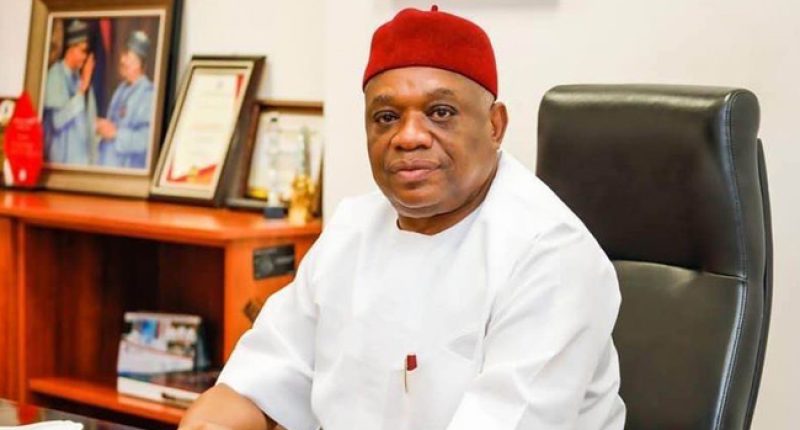
Senator Orji Uzor Kalu, who represents Abia North Senatorial District, has admitted that he previously traded in heavy weapons internationally, saying he sold arms to anybody who could afford to pay for them.
Kalu, a former governor of Abia State, made the disclosure during an interview on Arise Television on Monday, while discussing his business activities across Africa and his relationships with former and current South African leaders.
According to SaharaReporters, the senator said his former business involved heavy weapons traded between countries, and not small firearms.
When the anchor asked him directly whether he was an arms dealer, Kalu answered in the affirmative, but said he later abandoned the business following pressure from his parents.
“But my parents, my mother, my father came and said I must stop, and I stopped,” he said.
When asked whether he sold weapons to people who intended to use them to kill others, Kalu dismissed the concern, saying his primary motivation was making money.
“No, no, no, no, no, no. I was selling guns to make money, whether they blow up it’s not my business,” he said.
The interviewer also asked whether he supplied weapons to the African National Congress (ANC) during its struggle against apartheid in South Africa.
Kalu said he did not restrict his business to the ANC or any particular political organisation.
“No, I was selling to anybody who wants to buy. If you have the money, you want to buy in D.R.C, I sell to you, you want to buy in Namibia, you want to buy…” he said.
When pressed on where he obtained the weapons, the senator declined to disclose his suppliers or sources, insisting the information was private to his business.
“It’s only my business,” he said.
The anchor raised concerns about the proliferation of small arms in Nigeria and how Kalu’s former dealings related to the country’s security challenges.
Kalu clarified that the weapons involved were not small arms but heavy military equipment traded country to country.
“No, these are heavy arms that were sold country to country,” he said.
In another exchange, the interviewer asked whether he sold weapons to Libya under its former leader, Muammar Gaddafi.
Kalu maintained that his business was open to anybody with the financial capacity to buy.
“To anybody that had money to buy,” he said.
When the interviewer suggested that meant he also sold to Gaddafi, Kalu did not directly confirm or deny a specific transaction, but said he would have sold to the late Libyan leader if he had the money.
“May his soul rest in peace. He was a good man. If you have money to buy, when I was selling, I would sell to you,” he said.
Kalu did not disclose the period he operated the arms business, the companies or individuals involved, the volume of weapons traded, the specific countries or buyers he supplied, or whether the transactions were conducted through licensed international arms-trading arrangements.
Beyond the arms disclosure, Kalu also discussed his longstanding relationships with successive South African presidents, tracing the connections to his friendship with former President and anti-apartheid icon, Nelson Mandela.
According to him, Mandela introduced him to several prominent South African leaders, including former President Thabo Mbeki and current President Cyril Ramaphosa.
Kalu recounted that Mandela once explained the political considerations behind Mbeki emerging over Ramaphosa as his running mate within the ANC, saying Mbeki’s father had contributed more to the anti-apartheid struggle than Ramaphosa’s father.
He added that Mbeki subsequently introduced him to former President Jacob Zuma, and that his relationships with South Africa’s political leadership continued across successive administrations.