

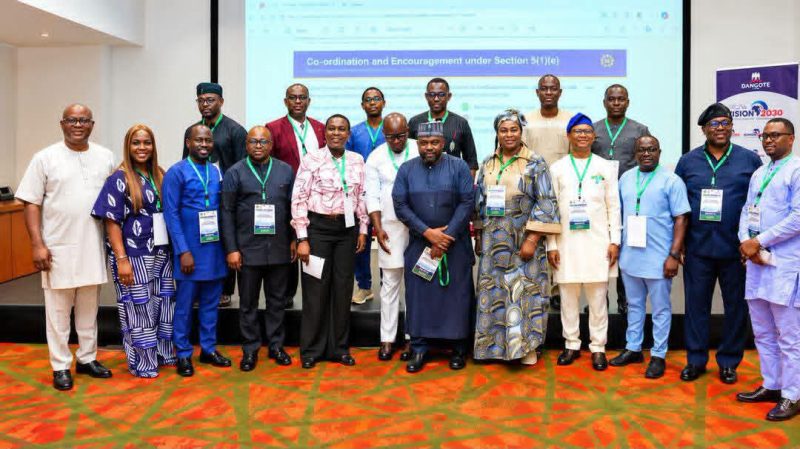
The Nigerian Content Development and Monitoring Board (NCDMB) and the Dangote Group have called for a shift from regulatory compliance to a national commitment driven by technology, innovation and sustainable financing to deepen Nigerian Content.
The call was made at a strategic retreat of the NCDMB/Dangote Joint Technical Committee (JTC) held in Lagos on Friday, themed “Beyond Compliance: Partnering for Sustainable Nigerian Content Development.”
The retreat brought together key stakeholders from the oil and gas industry and relevant government institutions to address operational challenges and expand indigenous participation across the energy value chain.
The discussions focused on ensuring Nigerian Content goes beyond statutory compliance to become a sustainable economic strategy that creates jobs, builds technical capacity, strengthens local supply chains and retains value in-country.
In his keynote address, the Executive Secretary of NCDMB, Engr. Felix Omatsola Ogbe, represented by the Senior Technical Adviser and Director, Project Certification and Authorisation Directorate (PCAD), Engr. Austin Uzoka, said commitment, technology and financing remain critical to building a resilient Nigerian Content ecosystem.
He challenged stakeholders to confront issues of industrial sustainability, including how to maintain major industrial assets, strengthen domestic supply chains and ensure critical infrastructure delivers lasting economic value.
Citing challenges with publicly owned refineries, Ogbe stressed the need to safeguard the sustainability of the Dangote Refinery by developing the goods, works, services and supply-chain capabilities required for its continuous operations.
He warned that without credible local supply chains, the economic benefits of industrial investments would continue to flow outside the country, limiting local value creation.
On technology, he underscored the need to develop Nigerian expertise to operate and maintain industrial facilities rather than relying on external support. He also identified access to finance as a major constraint, noting that high interest rates and funding delays hinder indigenous companies from executing projects and competing effectively.
Ogbe further called for support for emerging indigenous investors seeking to build refineries and related facilities, noting that a stronger domestic refining sector would position Nigeria as a major oil and gas hub. While commending Dangote Group’s pioneering role, he urged the industry to support the next generation of large-scale indigenous industrialists.
In his presentation, the Director of Planning, Research and Statistics and Chairman of the NCDMB/Dangote JTC, Mr. Omomehin Ajimijaye, urged contractors and service providers within the Dangote business ecosystem to comply with Nigerian Content requirements, register on the Nigerian Oil and Gas Industry Content Joint Qualification System (NOGICJQS) and deepen their participation.
He said the Board’s regulatory framework is designed to facilitate business growth, not create bottlenecks, and outlined four compliance pillars: Nigerian Content planning, workforce localisation, local procurement and capacity development.
Under the requirements, companies must submit Nigerian Content plans showing how they will maximise indigenous participation, prioritise qualified Nigerians, procure locally available goods and services, and invest in skills development and technology transfer.
On expatriate quota, he said foreign personnel could be engaged where genuine skills gaps exist, but companies must work with the Board to establish such gaps and develop succession plans for Nigerians to take over such roles.
Ajimijaye described NOGICJQS as a critical tool for supplier registration, prequalification and capacity verification, noting that reliable industry data would help identify skills gaps and direct training investments.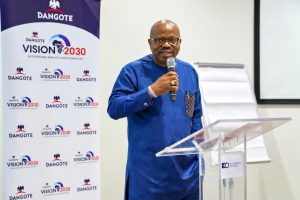
He commended Dangote Group for collaborating with the Board since 2019 to build capacity through local and overseas training, with some beneficiaries now employed within the group.
He disclosed that Nigerian Content interventions have retained over $10 billion in the economy, created more than 50,000 direct and indirect jobs, and supported over 50 million man-hours of training.
However, he said in-country value retention at about 61 per cent remains below the 70 per cent target, calling for stronger collaboration to close the gap.
In his welcome address, Group Vice President of Dangote Group, Dr. Edwin Devakumar, called for a shift from a compliance-driven mindset to a culture of national responsibility and ownership.
“For sustainable Nigerian Content development to succeed, it must not be seen as a regulatory burden. Every individual must regard it as something they genuinely want to do from the bottom of their heart,” he said.
Devakumar said local content must go beyond sourcing raw materials to include skills transfer, workforce development and growing indigenous contractors into firms capable of executing complex projects.
The Director of Legal Services, NCDMB, Dr. Naboth Onyesoh, called for greater coordination among regulators, stressing that investment facilitation, petroleum regulation and Nigerian Content compliance must work together.
He cautioned against the perception that the Oil and Gas Free Zones Authority (OGFZA) is the sole regulator in free zones, explaining that its investment promotion role does not override the mandates of other agencies.
He noted that businesses remain subject to requirements of the Nigerian Upstream Petroleum Regulatory Commission, the Nigerian Midstream and Downstream Petroleum Regulatory Authority and NCDMB, as well as the Central Bank of Nigeria, Customs and Immigration.
Reaffirming the centrality of the Nigerian Oil and Gas Industry Content Development Act, 2010, he said its provisions are key to promoting indigenous participation, technology transfer and employment.
“An incentive regime is a business advantage; it is not a regulatory exception,” Onyesoh said.
He highlighted the Board’s efforts to grow indigenous maritime capacity through the Nigerian Content Intervention Fund and its partnership with Nigeria LNG Limited on a shipyard project at Snake Island.
He also commended the Nigerian Maritime Administration and Safety Agency (NIMASA) for collaboration on vessel verification.
Onyesoh urged sustained inter-agency engagement, information sharing and joint resolution of operational challenges to improve ease of doing business, boost investor confidence and maximise economic returns from oil and gas.
Earlier, the Alternate Chairperson of the NCDMB/Dangote JTC, Dr. Ebele Oputa, described the retreat as a family meeting of stakeholders united by the goal of placing Nigerians at the centre of industrial development.
She commended Devakumar for his over 33 years in Nigeria and contributions to Nigerian Content development.


