

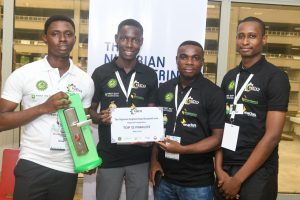
Two teams from the Universities of Port Harcourt, (UNIPORT) and Benin (UNIBEN) respectively have made it to the grand finale of the Nigerian Engineering Olympiad (NEO) representing the south south region.
The Olympiad is a nationwide engineering, innovation and entrepreneurship competition launched in 2025 by a non-profit organization, Enactus Nigeria to showcase hardware and software prototypes developed to serve as innovative solutions to real-world challenges, with specific reference to Nigeria and Africa.
The competition is in partnership with the Nigerian Content Development and Monitoring Board (NCDMB) and also wiith Renaissance Africa Energy Company Limited, First Exploration & Petroleum Development Company and the Nigerian Society of Engineers (NSE).
According to a statement on Tuesday by Dr. Obinna Ezeobi, General Manager Corporate Communications in NCDMB, the event was held at the Nigerian Content Tower in Yenagoa on Monday.
According to him, team Protronics representing UNIPORT and team Vhorde representing UNIBEN triumphed over other teams from schools from the south south including; Igbinedion University, Okada, Edo State, Federal University of Petroleum Resources (FUPRE), Effurun, Delta State, and University of Uyo, Uyo, Akwa Ibom State.
UNIPORT’s Team Protronics had as Team Lead Dr. Victor Jinn (Faculty Adviser), while the contestants were Chukwuma Sunday-Odu, Fubara David Otokini, and Ekemini Godwin Akpan.
Team Vhorde of University of Benin had Anoint Oritsetimeyin Igorki, Oghosa Derick Osarobo, Uti Henry Eworitsewarami, Jada O. Godfrey-Ariavie, Richard O.Enegbuna, Momodu O. Olayemi, and Asemota G. Ayevbosa.
From team Protronics was Keytric, which the group presented as “Smart Power Control Made Effortless” and “Automating electricity usage using intelligent locking systems.”
For the problem statement, the team highlighted high electricity bills, electricity fire risk and expensive smart homes, and proceeded to list gaps in existing solutions.
They include costly installation, as change in wiring is required; lack of integration between security and energy, and dependence on the Internet.
The Team’s solution is “A smart energy door lock that switches off a user’s electricity supply when they lock to leave the house.”
The students said their solution saves money on electricity bills, reduces the risk of electric fire accidents, and is affordable to everyone.
Team Vhorde of the University of Benin made a presentation on what it terms IRIS, Intelligent Real-time Interface for Sight, pointing out that there are 4.5 million visually impaired Nigerians who are in some way incapacitated and unable to live life to the fullest.
The students displayed an IRIS pack, which consisted of TOF sensors, wearable glasses, microphone, camera and Haptic feedback.
Explaining how the IRIS works, the team said the smart glasses, which consist of camera, depth sensor, and edge AI (Artificial Intelligence) processor, enable a visually impaired person to see and understand the world in real time.
There is also an AI Compute Unit, to be worn at the waist, which “runs CNN (convolutional neutral network) object detection, face recognition, and voice processing on-device.”
In a section on Business Model and Revenue Streams, the team indicated production-scale pricing for IRIS Standard as N699,000 (one-time purchase. IRIS Standard has the following functions: real-time object and scene identification, familiar face recognition, obstacle and hazard detection (haptic wristbands), natural voice interaction, Edge AI – fully offline core functions, and OTA software updates via Wi-Fi.
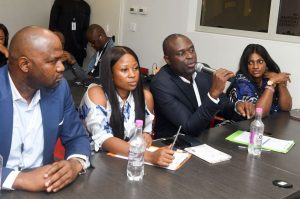
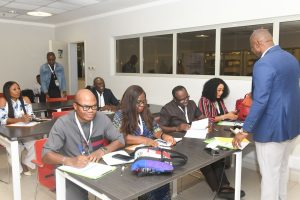
Giving an assessment of the prototypes and demonstrations made, one of the key judges of the competition, Engr. Dokubo Obongo, Manager, Institutional Strengthening, at the NCDMB, described all the presentations as “top-notch.”
Obongo noted that there are solutions that are viable–marketwise– and also relevant to Nigerian society and the challenges we face.
He explained that the Engineering Olympiad is a competition targeted at developing home-grown solutions from research and development from Nigerian universities.
According to him, the idea is to see how we can proffer solutions to our own problems, which means creating business opportunities.
Representing Enactus Nigeria, the group’s Country Director, Mr. Michael Ajayi, said the two top finalists from the six geopolitical zones would move to a boot camp for further preparation towards the main national championship, and that the best three teams would share N100 million.
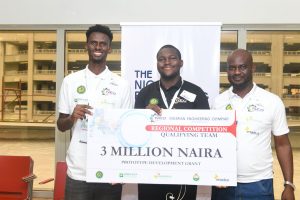
He also disclosed that each of the 30 teams that displayed prototype technology in the regional competition would receive N3 million.

