

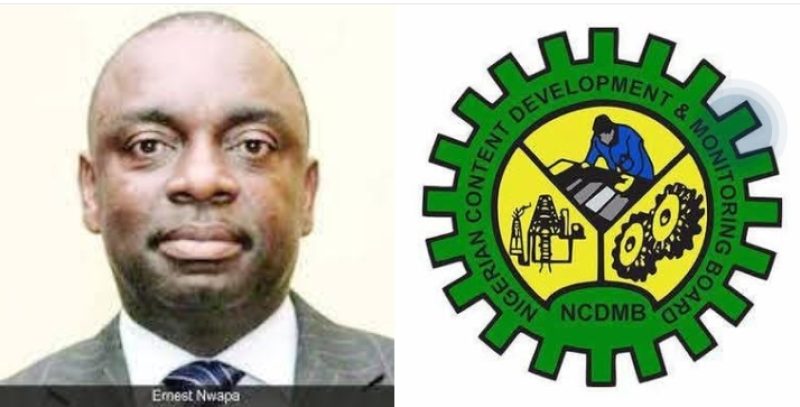
The pioneer Executive Secretary of the Nigerian Content Development and Monitoring Board (NCDMB), Dr. Ernest Nwapa, has dismissed the notion that the absence of Final Investment Decisions (FIDs) in the country’s oil and gas sector over a period of time was caused by stringent implementation of local content policies by the NCDMB.
This is as he addressed several industry issues while giving a presentation on the topic “Staying the Nigerian Content Course in the Midst of Delivery Challenges,” at the Nigerian Content Academy Lecture Series organised by the NCDMB which began on Friday.
According to him, “There are many government policies that are affecting FIDs.”
He admitted that the oil and gas industry stakeholders face “an increasingly complex environment shaped by global energy trends, shifting investment patterns and heightened expectations for local participation and value addition.”
On suggestions that the future of local content policies is under intense scrutiny, Nwapa, a one-time Group General Manager, Nigerian Content Division of the Nigerian National Petroleum Corporation (2005-2010) noted that such unfounded fears had always been advocated by some industry stakeholders averse to the idea of local content.
He drew attention to some unhealthy trends in the oil and gas industry, noting that “there are unintended ambiguities in the Presidential Directives” introduced in February 2024.
Such ambiguities, he pointed out, need to be addressed by stakeholders.
He regretted that the ambiguities in the Presidential Directives have created systemic problems, and that there has to be “institutional adjustment to re-enact the authority in the NCDMB directives.”
He decried what he described as “lack of respect for the authority of the NCDMB within some industry stakeholder groups,” arguing that “when the Board writes a letter and says this is what stands on Nigerian Content, nobody questions it.
“If you challenge a letter from the NCDMB, it wouldn’t stand.”
He said it is wrong for any agency to put aside a letter from the Board and continue doing things in its own way.
Nwapa, a fellow of the Nigerian Society of Engineers (FNSE), pointed out that Nigerian Content has been a national aspiration with mixed results since the Nigerian economic development model was conceived.
According to him, statutes like the Petroleum Act, 1969, the Joint Venture (JV) agreements, the Petroleum Technology Development Fund (PTDF), and creation of NAPIMS, all had been conceived to achieve some measure of local content.
There was also the Coastal and Inland Shipping (Cabotage) Act, 2003. But all these were incomparable to the Nigerian Oil and Gas Industry Content Development (NOGICD) Act, 2010.
In his words, “Our young engineers, our young technicians now have places to go to acquire practical skills” because a lot of projects are going on in the country.
“If you look at the number of Nigerians that worked in Egina at the Integration Yard [SHI-MCI Fabrication and Integration Yard, Tarkwa Bay, Lagos, it’s not something you can just underestimate.
“So we need to know there are serious consequences for failure of what we’ve started.”
He stated that “Things around high costs of local content…are things that we have to continue to work on to see how we can have them reduced.”
He further said that “if you don’t start practising local content and get your people involved, the costs gap will be wider and wider, “so it’s either you decide to bite the bullet right now and use activities within your local economy to drive the costs to competitive levels or you can forget about it and not do it at all.”
He advised that the cost of projects needs to be evaluated on a project-by-project basis and handled strategically by the Board.
He insisted that “NCDMB has “the power to do that, working with the industry players,” who would provide the information and matrices.
Nwapa also advised that the Nigerian Content Academy, a division of the NCDMB, should be “a place where we test theories, and we go outside to the field and have strong workshop discussions and analysis, and proffer practical recommendations,” which could be taken to the NCDMB Executive Secretary or right up to The Presidency.
When the moderator of the Lecture Series and Director of the Academy, Dr. Ama Ikuru, invited questions and comments from participants, Mr. Simeon Ogari, Nigerian Content Manager of SEPLAT Energy Limited, sought to know why there is Nigerian Oil and Gas Industry Content (NOGIC) Joint Qualification System (JQS) and a parallel JQS operated by NIPEX [Nigerian Petroleum Exchange].
Nwapa in his response said the situation had been so for some time but that it has not disrupted industry activities, and that differences could be sorted out in time.
Other participants who sought clarifications include Mr. Isoboye Amachree, of Oando PLC, Mr. Kamselem Mohammed and Barr. Naboth Onyesoh, Director, Legal Services, of NCDMB.
The Nigerian Content Academy Lecture Series are held weekly and are intended to raise awareness of trends and issues in the oil and gas industry, and thus empower Nigerians to take full advantage of economic opportunities in that sector.


