

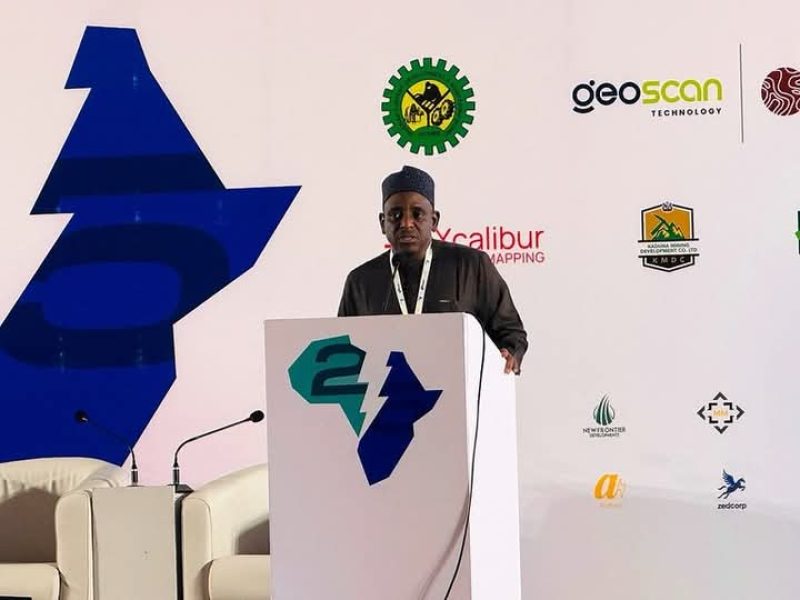
The Nigerian Content Development and Monitoring Board (NCDMB) has revealed that Nigeria’s mining industry is undergoing a dramatic transformation, declaring that it was driven by targeted local content policies from the Board.
NCDMB said these policies, showcased at the African Natural Resources and Energy Investment Summit in Abuja, are now being hailed as a blueprint for industrial growth across Africa.
This was disclosed by the Board’s General Manager of Corporate Communications, Dr. Obinna Ezeobi, via a press statement issued on Wednesday.
According to the statement, NCDMB’s Executive Secretary, Engr. Felix Omatsola Ogbe, explained that at the heart of the reforms is the Board’s strategic intervention in the barite value chain—a mineral critical to oil and gas drilling.
He outlined how the agency has spent over a decade building domestic capacity, from certifying reserves in six states to mandating exclusive procurement from local processors through the Nigerian Content Equipment Certificate (NCEC).
“Today, barite importation for drilling is prohibited in Nigeria,” Ogbe said, noting that “That didn’t happen by accident; it was made possible by deliberate policy instruments, stakeholder partnerships, and enforcement frameworks.”
Ogbe who was represented by NCDMB’s Director of Corporate Services, Dr. Abdulmalik Halilu, said the interventions have boosted value retention, created jobs, and positioned Nigeria as a continental model for mineral-based industrialisation.
According to him, similar policies are being rolled out in the steel and pipe manufacturing sectors, including a 2022 directive requiring in-country sourcing of bare line pipes and oil tubular goods.
“The reforms are reinforced by broader industrial support programmes such as the Nigerian Oil and Gas Industrial Parks (NOGAPS) and a $350 million Nigerian Content Intervention Fund managed in partnership with the Bank of Industry to scale up local manufacturing,” the statement noted.
The Minister of Solid Minerals, Dr. Dele Alake hinted that the clearest evidence of these reforms is visible in Nigeria’s expanding lithium and battery value chain.
He revealed that over $800 million in mining investments were secured in 2024 alone, following a major policy shift requiring all mining licences to include local processing plans.
He stated that the Nasarawa lithium battery plant, valued at $100 million, is already up and running.
In the words of Alake: “A $600 million lithium refinery near the Kaduna–Niger border is on the way. These facilities are anchored on one thing: local content.”
The minister added that government revenue from mining surged from ₦6 billion in 2023 to ₦38 billion in 2024—a six-fold increase credited to tighter licensing, enforcement of value-addition rules, and new industrial investments.
Corroborating the impact, Liberia’s Petroleum Regulatory Authority Chairman, Jake Kabakole, described Nigeria’s local content regime as a “continental model.”
He therefore urged African nations to adapt their legal and institutional frameworks to unlock similar outcomes.
NCDMB noted that the shift is not just regulatory but economic, disclosing that indigenous Nigerian firms now contribute 15% of oil production and 60% of domestic gas supply.
The Board added that engineering and fabrication companies such as Dormanlong, Saipem, and Aveon Offshore are executing complex projects previously handled by foreign multinationals.
“Beyond minerals and manufacturing, the NCDMB has also enforced local employment regulations through its partnership with COREN, ensuring that only certified Nigerian engineers are deployed on projects.
“In tandem, a customs alert system now prevents the importation of goods—such as cables, paints, and valves—that are produced locally.
“Local content is not a constraint; it is an enabler. When deployed intentionally, it becomes a lever for self-sufficiency, industrial growth, and economic sovereignty.
“As African leaders at the summit discussed regional energy integration and industrialisation, Nigeria’s example stood out,” the statement revealed.
It was gathered that delegates praised the country for turning policy into measurable outcomes—from factory construction to formalised artisanal mining cooperatives and electric vehicle assembly plans.
Also speaking at the summit, Nigeria’s Minister of Power, Adebayo Adelabu, emphasised that local content must be measurable.
He highlighted reforms under the Electricity Act 2023, which decentralised electricity governance and enabled 11 states to begin managing their own power markets.
Adelabu said the government is aligning its electrification drive with local manufacturing — including clean energy projects, meter assembly, and solar component production.
“The real value of local content lies in supply chains, technical jobs, and local ownership,” he stated.
Also speaking, Kenya’s Minister of Mining and Blue Economy, Hassan Ali Jobbo, offered a cautionary note, urging African nations to define their own priorities in the minerals sector rather than simply adopting classifications imposed by others.
“Africa has talked too long about potential without decisive action,” he said.
“We must decide for ourselves which minerals are critical to our future—not wait for outsiders to tell us.”


