

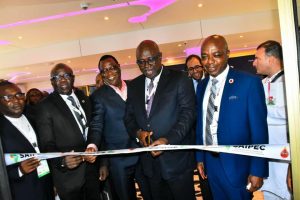
The Executive Secretary of the Nigerian Content Development and Monitoring Board (NCDMB), Engr. Felix Omatsola Ogbe, has tasked sub-Saharan African countries to keep pace with unfolding trends in the global oil and gas industry.
He also urged them to adopt a unified approach in strengthening local content development, advancing industrialisation and fostering sustainable continent-wide economic growth.
The NCDMB helmsman gave the admonition on Tuesday while delivering a keynote address at the 9th Sub-Saharan African International Petroleum Exhibition and Conference (SAIPEC).
Nations like Nigeria, Angola, and Ghana have made notable strides in local content development by boosting indigenous participation in the oil and gas sector, he acknowledged.
Ogbe however expressed regret that “fragmented implementation continues to hinder collective progress.”
He called for a collaborative strategy among petroleum-producing nations in sub-Saharan Africa that would foster the sharing of best practices and enhance cross-border partnerships that could drive the competitiveness of indigenous players.
Themed “Sub-Saharan Africa Local Content Collaboration Strategy,” Ogbe’s address identified harmonisation of local content policies, human capital development, investment in infrastructure, funding for local companies and technology transfer, as key pillars to Africa’s collaboration strategy.
“There is a need to develop a robust local content framework that positions the region for long-term economic prosperity,” he said.
The NCDMB boss added that this could be fostered “through the collaborative efforts of APPO [African Petroleum Producers Organisation] and the United Nations Economic Commission for Africa and the African Union.”
Ogbe also highlighted the importance of the African Continental Free Trade Agreement (AfCFTA) as a critical legal framework that could be leveraged to achieve collaborative local content strategy in Africa, given the free trade area it has created by integrating 1.3 billion people across 54 African countries with a combined gross domestic product of over $3 trillion.
In the area of human capital development, which he described as “pivotal to the successful implementation of local content,” Ogbe observed that approximately 60% of Africa’s population is currently under the age of 25, and that this teeming population provides a unique opportunity to fast-track development.
“A large, young workforce can drive expansion through increased productivity and expansion,” he said.
The NCDMB boss dwelt at length on how investment in infrastructure could catalyse regional economic growth.
He cited the 650,000-barrel-per-day Dangote Integrated Refinery and Petrochemical Company, noting that it would afford Nigeria and other African countries partnership opportunities for sourcing petroleum products and fertiliser.
Similar projects capable of leveraging collaborations include Kenya’s Konza Technology City, Grand Ethiopian Dam, Lekki Free Trade Zone (Lagos), and facilities like the SHI-MCI FPSO Fabrication/Integration Yard in Lagos.
Other projects highlighted by the Executive Secretary were NCDMB’s Nigerian Oil and Gas Parks Scheme (NOGAPS) being developed in seven locations in Nigeria, to which he invited interested businessmen and investors seeking to manufacture industry-related equipment, components and spares to apply.
According to him, “A regional fund or financial framework that provides credit facilities, guarantees, and investment incentives would strengthen indigenous firms.”
He expressed satisfaction that an African Energy Bank, established by APPO with the support of the NCDMB, which has taken equity investment in it, is soon to be operational.
He said that, “Encouraging joint ventures, research collaborations, and technology-sharing agreements among African nations will drive the adoption of cutting-edge solutions and indigenous technological advancements in the African economy.”
The overall strategy discussed by Ogbe envisages roles for the academia and research institutions, which must collaborate on industry-driven research, innovations, and skills development.
“By working together, we can create a formidable and self-reliant petroleum sector that delivers long-term benefits for our economies, businesses, and people,” he stated.
In a pre-event session on Monday, NCDMB’s Director of Monitoring and Evaluation, Mr. Abdulmalik Halilu, delivered a paper on “Optimisation of Developed Capacities and Capabilities in Africa for the Growth of African Oil and Gas Industry.”
In the presentation, with an illustration from Africa’s Hydrocarbon Map, Halilu spoke on the local content value proposition for Africa; its concepts and the way forward.
He highlighted research and technology development, local employment, strategic partnerships, ownership and control of assets.
He also threw light on sustainable operations, increased production and utilisation of locally made goods, and contribution to GDP.
Halilu advised petroleum-producing countries to “identify and develop niche industries, promote specialization and value addition, and establish export-oriented economic zones.”
For trade and regional integration under AfCFTA, his suggestion was to “harmonise trade policies and regulations, develop efficient transport and logistics networks, export expansion grants to companies promoting intra-Africa trade.”

