

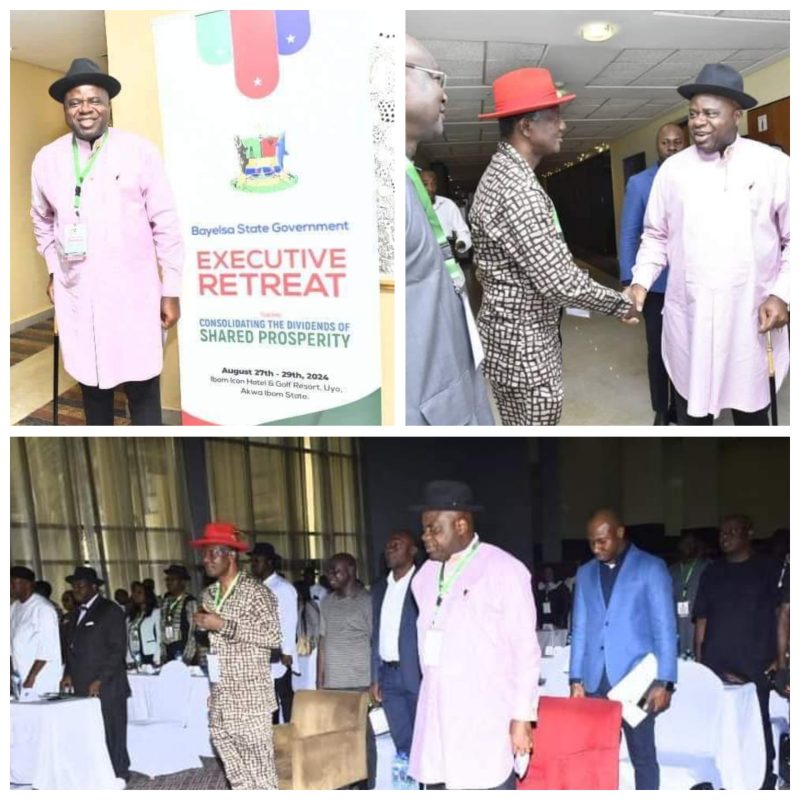
The Governor of Bayelsa State, Senator Douye Diri, has announced that his second-term agenda will be based on a comprehensive framework built on seven pillars, representing critical aspects of his administration’s developmental strategy.
Diri made this statement on Tuesday while opening a three-day State Executive Council Retreat with the theme: “Consolidating the Dividends of Shared Prosperity” in Uyo, Akwa Ibom State.
Delivering the keynote address, he emphasized that the retreat was crucial for key government officials to foster collaboration, drive innovation, and ensure that policies and programs align with common goals, as well as to build on his first-term efforts.
A statement from his Chief Press Secretary, Mr. Daniel Alabrah, quoted Diri as saying that his administration had developed an acronym, A.S.S.U.R.E.D, based on seven pillars that would serve as a beacon to ensure economic growth and social development.
The pillars are: Agricultural Revolution, Sports Development, Security, Urban Renewal, Robust Healthcare, Energy Generation, and Diversifying Education.
Diri explained that his administration was committed to ensuring food security by opening up opportunities to maximize the potential of the state’s blue economy.
He stated: “Beyond our collaboration with the CBN and the training of our youths at CSS Farms in Nasarawa State, I recently led a team to Seoul, South Korea, under the Korean International Cooperation Agency on an all-expenses-paid capacity-building trip sponsored by the South Korean Government.
“They also donated four sets of modern tractors and other agricultural equipment worth $488,400.”
Regarding sports and youth development, he noted that the state’s investment in sports infrastructure and programs aimed at nurturing talent, building character, and creating opportunities for the state’s youths.
On the agenda of consolidating security and peace, the governor emphasized that his administration was working tirelessly to enhance security measures to maintain the state’s status as one of the most peaceful in the country and to leverage this record for industrialization.
He also highlighted urban renewal and rural development as core pillars of the government, with ongoing investments in infrastructure, housing, transportation, and water supply.
“We aim to create modern, livable cities that support economic growth and improve the quality of life for our citizens.”
In promoting robust healthcare delivery as another area of focus, the governor said: “We are committed to investing in modern infrastructure to improve access to quality healthcare services for all our citizens, regardless of location.
“We have expanded the health insurance scheme to include citizens who are not civil servants.”
Regarding energy generation and economic growth, he assured that the state’s economy was being repositioned for growth and sustainability, with a focus on power generation, economic diversification, entrepreneurship, and empowerment programs that create opportunities for people.
To this end, Diri reiterated that the government has domesticated the Electricity Act in the state and is currently working on independent power generation to provide stable power supply.
According to him, another critical area is diversifying education by placing more emphasis on the development of technical and vocational education. The sector is being digitalized to meet contemporary standards.
“We are placing more emphasis on the development of technical and vocational education, building technical colleges in all our local government areas, which are now tuition-free with also free feeding for the students.
“We will continue to promptly accredit all programs in our tertiary institutions to guarantee educational outcomes. In the last four years, we have trained over 10,000 youths in various skills.”
The governor, who stressed the importance of teamwork, urged participants to generate sound ideas to actualize the administration’s prosperity agenda, adding that their primary responsibility was to serve the people.
Speaking on the topic “Teamwork: Key to Actualizing the Prosperity Agenda,” one of the resource persons, Mr. Kalada Apiafi, highlighted the characteristics of an effective team and the principles of delegation.
Also speaking on the lecture “Vision Setting, Governance, and Performance,” Dr. Joe Abah noted that of all the ills that harm the poor, none is as lethal as bad governance.
In his lecture “Policy Making and Implementation,” renowned public speaker Dr. Linus Okorie stated that while excellent visions and strategies can be conceived, only the zeal to implement them will transform the goals behind such ideas by a leader into reality.


